








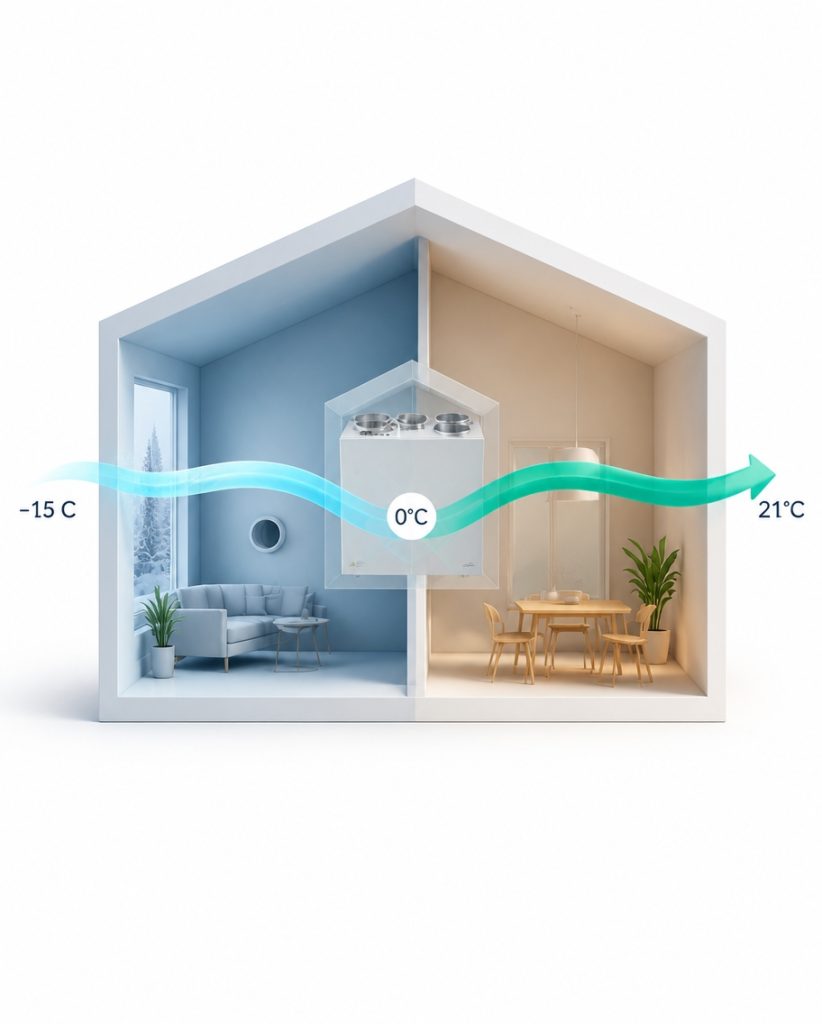
How heat-recovery ventilation survives winter – frost protection explained
At -15 °C outside, the warm, moist air extracted from the building meets a surface that is colder than ice – inside the heat-recovery core of the ventilation unit. That is where the two airflows exchange heat without mixing, and it is also where, without protection, moisture freezes into ice that blocks the exchanger and stops the air supply. Frost protection is the set of controls that prevents this: it decides, hour by hour through the coldest months, whether the system keeps ventilating, how much heat it saves, and how it recovers when temperatures drop further. For anyone specifying, installing or living with heat-recovery ventilation in a Nordic climate, understanding frost protection is not optional – it is the difference between a system that runs all winter and one that trips, ices up and calls for service.
This article explains what causes freezing in a heat-recovery ventilation system, when protection is needed, the strategies used to provide it, and what to check before choosing a unit for a cold climate.
Does heat-recovery ventilation freezes in winter?
A heat-recovery ventilator (HRV) moves two airflows through one core: warm, humid extract air from the house, and cold, dry outdoor supply air. They exchange heat through the core surfaces without ever mixing. When the surface temperature of the core falls below the dew point of the extract air, moisture condenses on the plates – and when the surface is below 0 °C, that condensate freezes. Ice builds first where the exhaust air enters the core, then grows back into the airflow channels. The result is reduced ventilation, higher fan power, condensate overflow and, in the worst case, a unit that must shut down to thaw. Freezing is therefore a design condition, not a error: every system used in a cold climate must be engineered to expect it.
When frost protection starts
The trigger is physics, and it is calculable. Analysing residential units in Swedish apartment buildings, Per Kempe shows in the REHVA Journal that a counter-flow exchanger with 80% efficiency, balanced airflows and 21°C extract air begins to condense and frost at around -3 °C outdoors; units need defrosting when the outdoor temperature drops below roughly -2 °C, and the exact threshold depends on the exchanger’s efficiency and the airflow balance. The higher the declared heat-recovery efficiency, the earlier in autumn the frost risk arrives – because the extract air is cooled closer to the outdoor temperature on the cold surfaces.
How much this matters depends on where you build. Kempe’s tables, based on Swedish Meteorological and Hydrological Institute climate data, count roughly 990 hours per year below -2 °C in Stockholm, about 2.000 in Umeå and over 3,800 in Kiruna. In large parts of Norway and Sweden, then, frost protection is not an edge case – it is one of the main operating modes of the ventilation system.
The protection strategies
Manufacturers protect the core in a handful of standard ways. A REHVA Journal review of frost-protection measures for energy-recovery systems lists the practical options, and a specification sheet should state clearly which one — or which combination — a unit uses:
- Supply-air preheating. An electric or water-heated preheater warms the outdoor air to around -2 °C before it reaches the core, keeping the exchanger above freezing. Reliable – but the preheater’s energy comes straight off the recovery benefit;
- Outdoor-air bypass. Flaps route the cold outdoor air around the exchanger while its surface sensor reads near freezing. Ventilation continues, but heat recovery pauses while the bypass is open. A more refined version uses the extract-air dew point instead of temperature alone, so the bypass only opens when condensation is actually likely;
- Airflow reduction (imbalance). The unit temporarily reduces the cold supply airflow, or increases the warm extract flow, so the core warms above freezing. Recovery efficiency drops while the imbalance lasts, then resumes;
- Defrost cycle. The unit periodically pauses or redirects the supply air and uses warm extract air to thaw the core. Ventilation is interrupted briefly and repeatedly; during defrosting, recovered heat can drop to about half, with a corresponding need for re-heating;
- Wheel-speed control. On rotary units, the control slows or temporarily stops the heat-recovery wheel so warm extract air flushes frost out of the exchanger instead of transferring its heat.
Rotary exchangers and plate exchangers in winter
The exchanger type shapes the unit behavior. In the same REHVA analysis of residential units, units with heat-recovery wheels showed significantly less freezing than plate exchangers and a degree of moisture return, which keeps indoor air from drying out in winter; counterflow units, by contrast, need defrosting from around −2 °C but are preferred in apartment buildings where odor transfer between dwellings must be avoided. Neither type is frost-free: a rotary unit still relies on its wheel-speed control and temperature sensors to decide when to act, and the frost strategy it ships with is part of its engineering, not an accessory.
What frost protection costs
Frost protection always has a price, and an honest specification states it. Preheating consumes energy that would otherwise be recovered; an open bypass pauses heat recovery; a reduced supply airflow temporarily lowers the fresh-air rate to the rooms; defrost cycling interrupts the ventilation rhythm and halves the recovered heat while it runs. Simulations published in the REHVA Journal comparing frost-protection strategies in different European climates reach a conclusion every specifier should keep: there is no single best strategy for all of Europe – the right choice depends on the local winter profile of the installation site. What distinguishes a well-engineered unit is how little intervention its control needs, and how quickly full heat recovery resumes after each frost event.
What to check before you specify:
For specifiers, distributors and installation contractors, the frost question is concrete and checkable. Before choosing a heat-recovery ventilation system, ask:
- At what outdoor temperature does frost protection engage, and which strategy -or combination – does the unit use?
- Is the protection controlled on temperature alone, or on the dew point of the extract air?
- What happens to supply air temperature and room comfort during defrost – and how quickly does full heat recovery resume?
- Is heat-recovery performance documented with measured curves across the operating range, rather than a single nominal value?
- Are the temperature sensors that drive frost control positioned and documented (outdoor, supply, extract, exhaust)?
Frequently asked questions:
Why does my HRV ice up?
Ice forms when moisture from the warm extract air condenses on core surfaces that are below 0 °C. It starts at the cold end of the exchanger and grows into the airflow channels. Frost protection is designed to prevent it – if ice keeps forming, the threshold, the strategy or the airflow balance needs checking.
At what outdoor temperature does an HRV need frost protection?
For residential counter-flow units, analysis of measured Swedish installations points to defrosting being needed from roughly -2 to -3 °C outdoors, depending on the exchanger’s efficiency and the airflow balance. The higher the declared efficiency, the earlier the frost risk starts in autumn.
Does frost protection stop ventilation?
Temporarily, in some strategies. Defrost cycles and supply-air shutdowns pause ventilation for short periods; preheating, bypass and wheel-speed control keep ventilation running throughout. The strategy the manufacturer uses decides how often, and for how long, ventilation is interrupted.
Is a rotary heat exchanger better in winter?
In European field analysis of residential units, heat-recovery wheels showed significantly less freezing than plate exchangers and some moisture return, which limits winter dryness indoors. They still require frost protection and correct sensor placement – cold winters affect every exchanger type.
Sources
Kempe, P. (2022) – Frosting in residential heat recovery units. REHVA Journal, 2/2022, pp. 58 – 63. Federation of European Heating, Ventilation and Air Conditioning Associations.
Ahmed, R. & Appelhoff, J. – Frost-protection measures in energy recuperation with multiple counterflow heat exchangers. REHVA Journal. Federation of European Heating, Ventilation and Air Conditioning Associations.
Kanaś, P. et al. (2024) – Frost accumulation in the non-hygroscopic rotary heat exchanger. International Journal of Heat and Mass Transfer.
